
Wildlife at La Leona Waterfall: Monkeys, Birds and Animals in Guanacaste

By Michael López | Finca Curubanda, Curubande, Costa Rica

What local wildlife can I see on La Leona Waterfall tours in Guanacaste?
On a La Leona Waterfall tour in Curubande, Guanacaste, you may encounter howler monkeys, white-faced capuchins, spider monkeys, tropical birds, butterflies and other insects. Our local observations in the surrounding area also include white-tailed deer and agoutis. Wildlife moves freely, so the animals you see will vary from one visit to another.
At Finca Curubanda, we encourage visitors to pay attention to the forest as well as the waterfall. A call overhead, movement in the canopy or a line of ants crossing the ground can reveal another part of the experience.
This guide combines our local observations with species information to help you recognize some of the animals found around Curubande. It also explains what you should realistically expect from a waterfall hike: opportunities to observe wildlife along the way, without guaranteed sightings.
Mantled howler monkey with dark fur and a golden-brown mantle. Butterfly with open wings displaying its colors and markings. White-faced capuchin monkey with cream-colored fur around its face and shoulders.
The Forest Around La Leona Waterfall
Curubande is near Liberia, Guanacaste, in the wider Rincon de la Vieja area. The landscape around the waterfall includes tropical dry forest, riverbank vegetation and a rocky river canyon.
These environments offer different places to look for wildlife. Monkeys move through the canopy, birds perch among branches, and insects can be seen on vegetation or near the water.
A tropical dry forest changes with the seasons. Some trees lose leaves during drier periods, while rain brings fresh growth. The vegetation beside the river can look different from the surrounding hillsides.
The waterfall tour passes through this landscape, but it is also an active adventure involving uneven terrain, river crossings and swimming. Wildlife observation takes place where the route and conditions allow the group to stop.

Three Types of Monkeys Found Around Curubande
Our local observations include three types of monkeys: howler monkeys, white-faced capuchins and spider monkeys.
These three groups are also documented in the tropical dry forests of the wider Guanacaste conservation area. Their presence in the region does not mean that visitors will see all three during one hike.
Mantled Howler Monkey: The Mono Congo

Scientific name: Alouatta palliata
Local names: Mono congo, mono aullador
Howler monkeys have a sturdy build and mostly dark fur, often with longer brownish or golden hair along their sides.
Their deep calls are one of their most recognizable features. You may hear a howler before you find it among the leaves. The sound can seem surprisingly powerful when the animal itself remains hidden overhead.
When looking for them, scan the larger branches carefully. A monkey resting in the canopy may be much less obvious than one moving between trees.
Identification clues: Dark body, heavier build and a deep, carrying call.
White-Faced Capuchin: The Mono Carablanca

Scientific name: Cebus imitator
Local name: Mono carablanca
White-faced capuchins are recognizable by the contrast between their dark body and the pale fur around their face, neck and shoulders.
They are active, adaptable monkeys that investigate their surroundings while searching for food. Watching a group move through the trees can reveal very different behavior from that of a resting howler.
The white-faced capuchin found in Costa Rica is commonly called the Panamanian white-faced or white-throated capuchin in English. Despite that name, its natural range includes Costa Rica.
Identification clues: Pale face and shoulders, dark body and active movement through branches.
Observe them from a distance and keep food packed away. Wild monkeys should never be fed or encouraged to approach.
Geoffroy’s Spider Monkey: The Mono Araña

Scientific name: Ateles geoffroyi
Local names: Mono araña, mono colorado
Spider monkeys have long limbs, a slim body and a long, grasping tail. Their fur can include brown, reddish, buff and darker tones.
Their body shape is particularly useful for identification. When moving through branches, their long arms, legs and tail give them the appearance that inspired the name “spider monkey.”
The tail helps them hold onto branches as they travel or feed in the canopy. Fruit is an important part of their diet.
Identification clues: Slender build, exceptionally long limbs and a long tail used for gripping.
Spider monkeys have been observed in our area, but seeing them on a particular departure depends on where they are moving and feeding.
Birds to Look and Listen for Around La Leona Waterfall
Birdwatching adds another dimension to a visit to Curubande. Some birds reveal themselves through color or movement; others are easier to notice by their calls.
The birds below are based on local observations shared by our team. They are possibilities to look for, rather than a checklist every tour will complete.
Keel-Billed Toucan: Tucán Pico Iris

Scientific name: Ramphastos sulfuratus
The keel-billed toucan is recognizable by its large, multicolored bill, dark body and yellow throat.
Despite those bright features, a toucan can be difficult to locate when foliage blocks the view. Look carefully at exposed branches and treetops when your guide points one out.
The species is also known as the rainbow-billed toucan, reflecting its distinctive bill.
For this guide, we include the keel-billed toucan specifically. Other toucans should be identified from a clear observation or photograph before being added to the local list.
Elegant Trogon

Scientific name: Trogon elegans
The elegant trogon is one of the colorful birds reported in our area. Adult males have green upperparts and a red lower belly, while females have more subdued brownish coloration above.
Trogons can remain still on a branch, making them easy to overlook even when their plumage is colorful. Their upright posture and long tail can help you notice them.
The elegant trogon is documented in Guanacaste alongside the black-headed trogon.
What Is the Yellow-Bellied Trogon?

Visitors sometimes describe a trogon simply as “the one with the yellow chest.”
One regional possibility is the black-headed trogon, Trogon melanocephalus, also called trogón cabecinegro or viuda amarilla. However, yellow underparts alone are not enough to confirm its identity.
The head, eye ring, back and tail pattern also matter. A photograph can help distinguish it from other trogons with yellow underparts.
Laughing Falcon: The Huaco or Guaco
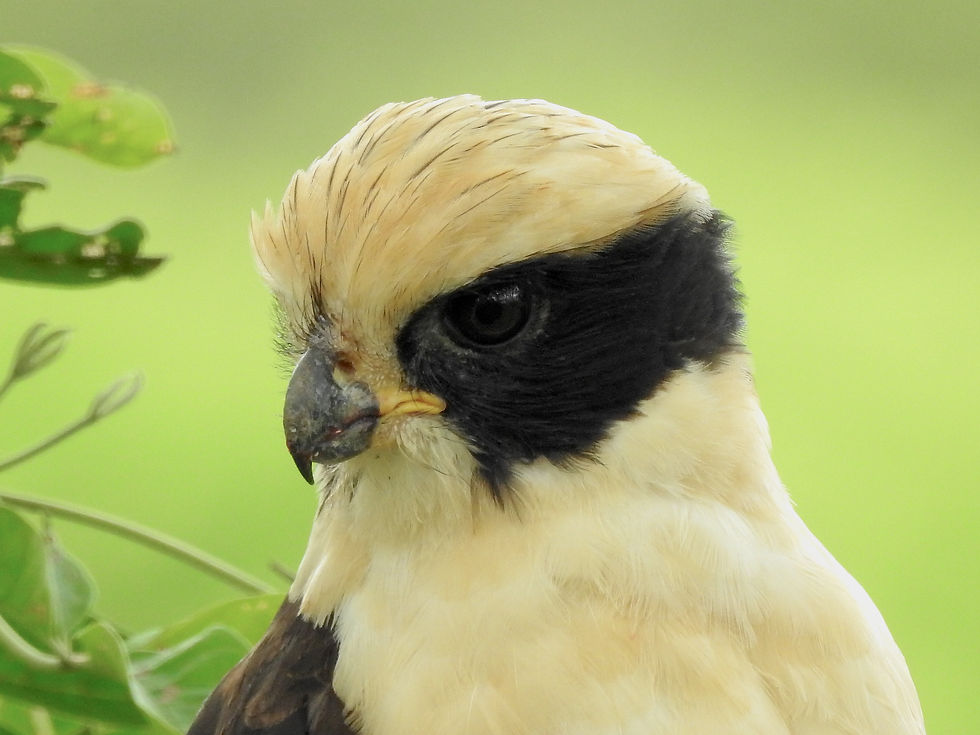
Scientific name: Herpetotheres cachinnans
The laughing falcon has a pale head and underparts, with a broad dark mask across the eyes.
Its far-carrying call is especially distinctive and gives the bird its English name. Locally, visitors may hear it referred to as the huaco or guaco.
It feeds largely on snakes and may perch on an exposed branch while watching its surroundings.
Identification clues: Cream-colored head, dark eye mask and a loud, laughing call.
White-Throated Magpie-Jay: The Urraca

The white-throated magpie-jay is a striking blue-and-white bird with a long tail and a noticeable crest.
Known locally as the urraca, it is one of the birds to watch for around woodland and the surrounding countryside.
Its combination of size, blue upperparts, pale underside and dark head markings makes it a memorable bird to recognize.
Long-Tailed Manakin: The Toledo

Scientific name: Chiroxiphia linearis
Local names: Toledo, saltarín
The adult male long-tailed manakin has a black body, a blue back, a red crown and elongated central tail feathers. Females are mostly green and much less conspicuous.
This is a small bird, so spotting one takes a different kind of attention from finding a toucan or a large jay.
The name “toledo” is associated with one of its recognizable vocalizations. Learning the call before your visit can make listening to the forest more rewarding.
Montezuma Oropendola

Scientific name: Psarocolius montezuma
The Montezuma oropendola is a large bird with a chestnut-colored body, a dark head and bright yellow outer tail feathers.
Its bubbling, gurgling song is another distinctive forest sound. Where there is an active nesting colony, long hanging nests may be visible high in the trees, although a tour does not necessarily pass a nesting site.
Parrots and Parakeets
Parrots and parakeets are also part of the wildlife observed around Curubande.
Visitors may notice their calls or see a group flying overhead. Identifying the exact species can be difficult during a brief sighting, especially when the birds appear as silhouettes.
Rather than identifying every green bird as the same species, we encourage visitors to ask their guide and use photographs when possible.
Deer and Agoutis Around Curubande
White-Tailed Deer

Scientific name: Odocoileus virginianus Local name: Venado cola blanca
White-tailed deer are among the mammals observed in the surrounding area.
Their brownish coat helps them blend into vegetation. A sighting may be brief, so pause where your guide indicates and avoid approaching or following the animal.
They are a possible encounter in the local landscape, not a promised part of the waterfall itinerary.
Central American Agouti

Scientific name: Dasyprocta punctata Local names: Guatusa, guatuza
An agouti is a ground-dwelling rodent with a rounded body, slender legs and coarse brownish to orange-brown fur.
Visitors sometimes mistake it for another small mammal when it moves quickly through the vegetation. Agoutis feed on plant material, including fruits and seeds, and are documented in Guanacaste.
Look toward the forest floor as well as the canopy. Not every wildlife encounter happens overhead.
Insects Along the Trail
Some of the most interesting animals on the hike are also the easiest to overlook.
Local observations include cicadas, dragonflies, beetles, butterflies, leaf-cutter ants and stinging ants commonly called fire ants.
Cicadas

Cicadas, known locally as chicharras, contribute to the forest’s soundscape. You may hear them clearly without locating an individual on a tree.
Dragonflies and Beetles
Dragonflies can be seen near the water and surrounding vegetation. Beetles vary widely in size, shape and color, giving visitors plenty of smaller details to notice along the route.
Leaf-Cutter Ants

Leaf-cutter ants, called hormigas cortadoras de hojas or zompopas, are particularly interesting to watch when workers carry pieces of leaves along a trail.
Pause without blocking their path or disturbing the colony.
Fire Ants and Other Stinging Ants

Some ants in the area can deliver painful stings. Avoid standing on visible ant trails or disturbing nests.
There is plenty to observe without touching insects or placing your hands into vegetation.
Are There Snakes at La Leona Waterfall?
Snakes live in the surrounding natural environment, but encounters are not a routine feature of every waterfall hike.
Local observations in the wider area include snakes known as cascabel, terciopelo, coral, falsa coral and lora. These common names do not all identify a single species with certainty.
The terciopelo, Bothrops asper, is often called the fer-de-lance in English. Costa Rica also has rattlesnakes and several species of venomous coral snakes. Other snakes can resemble them.

The name “lora” needs particular care because local names can be applied to different green snakes. Color alone should never be used to decide whether a snake is harmless.

cascabel

Can You See Sloths at La Leona Waterfall?
Do not plan a La Leona Waterfall tour expecting to see sloths. They are not part of our usual wildlife sightings on this route.

Curubande’s tropical dry forest differs from the wetter forest environments associated with many sloth-viewing experiences.
However, it would be inaccurate to say that sloths need cold weather. Habitat suitability depends on the species, forest conditions and available resources. Hoffmann’s two-toed sloth, for example, is described as rare or absent in lowland dry forest.
If seeing a sloth is the main goal of your trip, arrange a separate experience in an appropriate habitat rather than relying on a waterfall tour in Curubande.
What About Jaguars, Ocelots and Other Wild Cats?
Wild cats form part of Costa Rica’s wider biodiversity, but they should not be presented as animals visitors can expect to see on a standard La Leona Waterfall hike.
A species being present in a broader region is different from having a reliable chance of observing it beside a busy daytime trail.
It is also useful to distinguish two names:
Manigordo: the ocelot, Leopardus pardalis.
Jaguarundi: a different wild cat, not another name for the ocelot.
Costa Rica’s National Museum treats these as separate species in its information on the country’s felines.
For visitors, the realistic focus of this tour is the waterfall, the forest and the wildlife that happens to be visible during the hike—not tracking large cats.


How to Enjoy Wildlife Watching During Your Tour
Tell your guide before departure if monkeys, birds or photography are important to you. This helps the guide understand your interests while managing the route and the group.
During the hike:
Listen as well as look; calls may reveal animals hidden by foliage.
Keep your voice low when wildlife is nearby.
Observe from the trail and follow your guide’s directions.
Keep food packed away and never feed animals.
Use your camera’s zoom instead of moving closer.
Keep equipment protected during river crossings and swimming sections.
A waterfall hike has a different pace from a dedicated birdwatching outing. If you want extended observation time, discuss that before booking so the team can explain what is practical.
Listen to Wildlife Sounds Before You Visit
Learning a few calls can help you recognize what you hear in the forest.
Start with the howler monkey, laughing falcon, long-tailed manakin and Montezuma oropendola. Their sounds are quite different, making them useful species to learn first.
For bird recordings, explore the species resources available through Cornell Lab’s Macaulay Library.
Listen before your visit or with headphones afterward. During the tour, let the natural sounds of the forest take the place of recordings played aloud.
Frequently Asked Questions About La Leona Waterfall Wildlife
Can I see monkeys on a La Leona Waterfall tour?
Yes, monkeys are a possible sighting. Howler monkeys, white-faced capuchins and spider monkeys have been observed in the local area. Seeing any particular species depends on its movements and visibility during your visit.
Will I see all three types of monkeys?
Not necessarily. The presence of three species in the area does not mean all three will appear on one departure.
Can I see toucans near La Leona Waterfall?
Keel-billed toucans are among the birds reported locally. Look for a large, multicolored bill, a dark body and a yellow throat. Sightings are not guaranteed.
What makes the loud roaring sound in the trees?
One possible source is a howler monkey. Its deep call can carry through the forest even when the animal is out of sight. Your guide can help distinguish it from other sounds.
Are there sloths on the tour?
Sloths are not a usual sighting on our La Leona Waterfall route. Choose a separate sloth-focused visit if that is a priority.
Do people frequently encounter snakes on the trail?
According to our local experience, snake sightings are occasional rather than a feature of every tour. Remain on the route and follow your guide’s instructions if one is seen.
Is this a dedicated wildlife tour?
The standard La Leona experience is a guided waterfall adventure with opportunities to observe wildlife along the way. It is not a wildlife safari or a dedicated birdwatching tour.
Can children enjoy the wildlife?
Yes. Looking for monkeys, listening for birds and noticing insects can make the hike interesting for children. Participation in the waterfall activity still depends on the route, conditions and the child’s suitability.
Are animal sightings guaranteed?
No. The animals are wild and move freely. Some visits include several sightings; others offer more sounds, brief glimpses or smaller creatures along the trail.
Explore La Leona Waterfall with Finca Curubanda
The waterfall is the destination, but the forest is part of the experience.
At Finca Curubanda, we organize guided La Leona Waterfall tours from Curubande, near Liberia, Guanacaste. Let us know if you are especially interested in wildlife so we can help you choose a suitable departure and explain what to expect.
Learn more about the village and nearby activities in our local guide to things to do in Curubande, or contact Finca Curubanda to plan your visit.
Comments